Wayeal

Resource Topic

Helium Spray Method

A practical guide to using helium spray testing to localize leaks on evacuated parts with a helium mass spectrometer leak detector.

1 Video

Video Demonstration

See the Method in Action

YouTube Video

Helium Spray Method Video

Short demonstration video for the helium spray method used to localize leaks on evacuated parts.

Open on YouTube
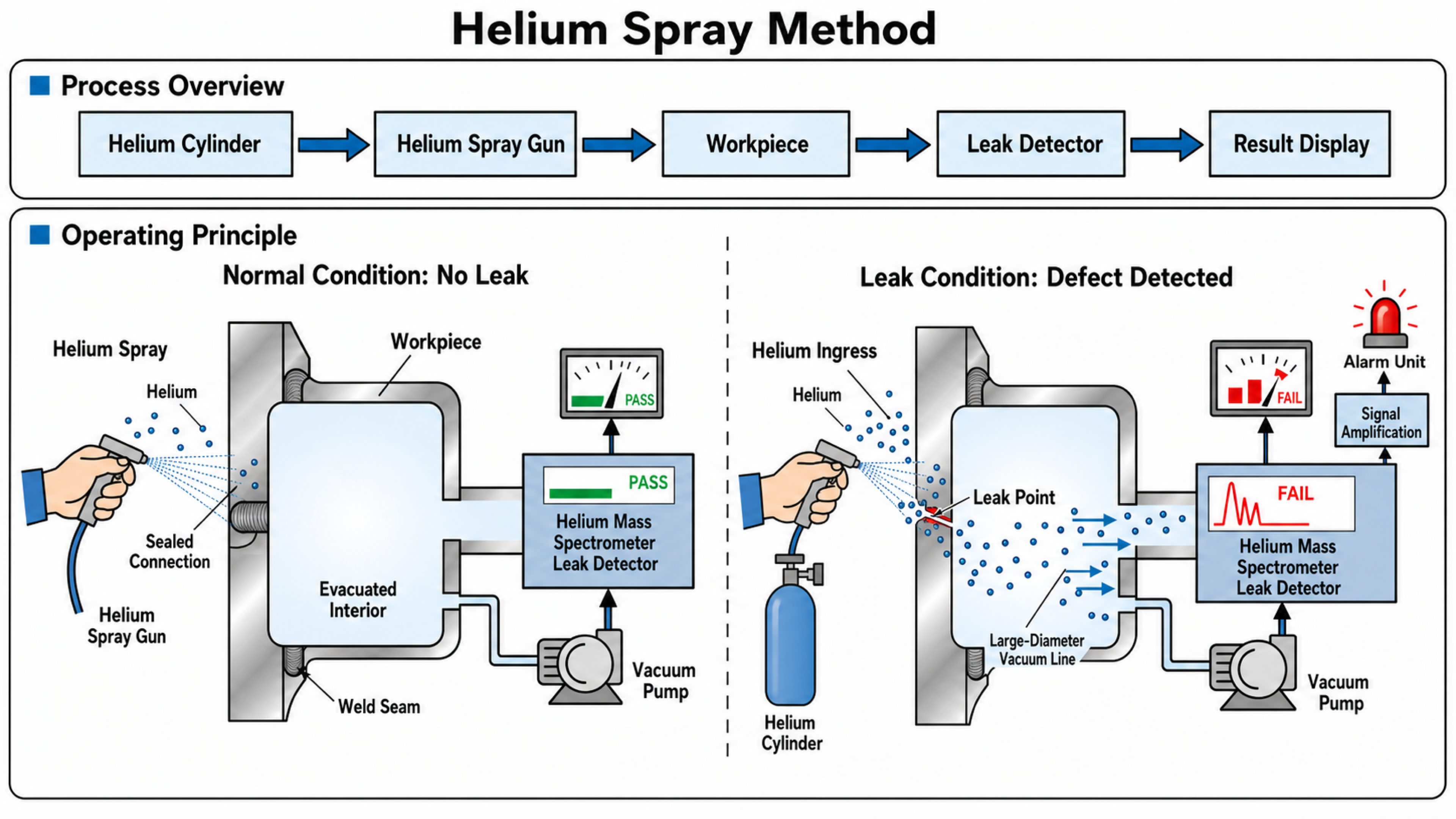
Helium spray method workflow and operating principle for an evacuated workpiece connected to a helium mass spectrometer leak detector
In the helium spray method, the workpiece is evacuated and helium is applied outside suspected leak areas. A leak path draws helium into the detector and produces a measured response.
Best fit
Vacuum-capable workpieces and assemblies
Primary purpose
Precise leak localization after evacuation
Tracer gas
Helium applied externally with a spray gun
Detector signal
Mass spectrometer response and pass/fail result

The helium spray method is a vacuum-side tracer gas technique for finding where a leak is located, not only whether a part leaks. The workpiece, vessel, pipe, or sealed assembly is connected to a helium mass spectrometer leak detector and evacuated. Helium is then sprayed onto suspected external surfaces. If a leak path exists, helium is pulled through the defect and detected by the instrument.

For potential customers, the method is valuable because it connects engineering evidence to practical repair decisions. Instead of replacing parts blindly, teams can test weld seams, flanges, threaded connections, brazed joints, seals, ports, and tooling interfaces in a controlled sequence and mark the locations that actually generate a detector response.

Method selection

When the helium spray method is the right choice

Use helium spray testing when the part can safely tolerate evacuation and the leak path must be localized from the outside. It is especially useful after a gross leak check, during prototype troubleshooting, after repair, or when a vacuum chamber or production station needs a diagnostic method before final process approval.

Compared with sniffer testing on a pressurized part, the spray method generally gives stronger sensitivity because helium is drawn into the evacuated volume instead of escaping into ambient air and being diluted before the probe can collect it. Sniffer testing remains useful for pressure-side parts and field checks, but the spray method is preferred when the part geometry and process allow vacuum-side testing.

Vacuum vessels and chambers

Locate leaks around doors, viewports, feedthroughs, vacuum flanges, welds, valves, and pump connections.

Heat exchangers and sealed circuits

Check brazed seams, headers, tube joints, welded ports, and repair areas after the circuit is connected to a detector.

Power and electrical equipment

Inspect sealed tanks, gas-insulated components, vacuum interrupter assemblies, and welded or bolted interfaces.

Production troubleshooting

Confirm whether a recurring leak signal comes from the workpiece, fixture seal, adapter, vacuum line, or test tooling.

Workflow

Typical helium spray test workflow

  1. 1

    Connect and evacuate the workpiece

    Seal the workpiece to the leak detector or test fixture, then evacuate it to a pressure range where the detector can operate with stable sensitivity.

  2. 2

    Stabilize the background

    Allow the leak detector reading to settle, confirm the system is not saturated by residual helium, and verify that fixture seals are not dominating the signal.

  3. 3

    Spray suspected areas systematically

    Apply helium from a spray gun to weld seams, joints, connectors, and sealing faces in a controlled order instead of flooding the whole part at once.

  4. 4

    Watch the response and mark peaks

    A real leak produces a delayed but repeatable rise in the helium signal. The maximum response helps localize the leak zone.

  5. 5

    Repair, clean down, and retest

    After the first leak is found and repaired, repeat the inspection to find smaller leaks that may have been masked by the original large leak.

Operating principle

What happens inside the detector

The pressure difference between atmosphere and the evacuated workpiece drives helium through any open leak path. The helium travels through the internal volume, fixture, and vacuum line to the mass spectrometer leak detector. The detector separates helium from the gas stream and converts the helium signal into a leak-rate reading or pass/fail indication.

Response time depends on internal volume, line length, conductance, pumping speed, leak size, and the amount of helium applied. Small parts and short lines respond quickly; large cavities and long pipe runs may need a deliberate waiting time before the peak appears.

Sensitivity

Spray method versus sniffer method

The Wayeal SFJ-231 supports both vacuum-mode and sniffer-mode leak detection. Vacuum-side testing can reach much lower detectable leak rates than sniffer-mode localization because the detector is connected directly to the evacuated test volume.

Sniffer sensitivity is affected by leak shape, probe distance, probe angle, scanning speed, nozzle shape, suction capacity, and the helium background concentration in the surrounding air. Those same practical factors still matter during spray testing, but the vacuum connection gives the spray method a more direct measurement path when the part can be evacuated.

  • Use spray testing when the workpiece can be evacuated and leak localization accuracy is important.
  • Use sniffer testing when the workpiece must be pressurized or cannot be placed under vacuum.
  • Use a vacuum chamber or integral method when the goal is a total leak-rate result rather than locating the exact leak point.

Result stability

Factors that affect the helium signal

  • Helium flow rate and spray duration: too little helium can miss a small leak; too much can saturate the area and make localization slower.
  • Distance and angle of the spray gun: keep the application controlled and repeatable around each suspected point.
  • Workpiece volume and connection length: large internal volumes and long vacuum lines delay the detector response.
  • Background helium: poor ventilation or repeated heavy spraying can raise the room background and reduce confidence.
  • Fixture and adapter integrity: a leak at the test connection can look like a product defect unless it is checked separately.
  • Operator scan sequence: a consistent route makes the result easier to interpret and repeat after repair.

Precautions

Operational precautions from field practice

  • Confirm that the workpiece can withstand negative pressure before evacuation, especially thin-wall parts, tanks, and assemblies with flexible sections.
  • Find and repair large leaks first. A large leak can mask smaller leaks and flood the detector response.
  • When two suspected leak points are close together, cover one point and use the finest spray nozzle on the other point to separate the signals.
  • If the leak detector changes slowly after spraying one point and the reading is inconsistent, suspect a larger nearby leak or a delayed response path.
  • After any leak is found, repeat the test several times after repair to confirm that the signal is gone and no secondary leaks remain.
  • Keep the test area well ventilated, but do not direct airflow across the helium spray path in a way that pushes helium away from the suspect point.
  • Avoid contaminating the test environment with excessive helium. High background makes subsequent small-leak detection slower and less reliable.
  • For large cavities or long pipelines, use a known reference leak or controlled helium introduction at the far end to estimate detector response time before judging each spray point.
  • Follow a defined sequence, typically top to bottom and near to far, so the operator does not chase residual helium from a previous location.
  • During rough search, use a broader spray pattern to cover area quickly; after the leak zone is found, switch to a smaller nozzle to locate the exact point.

Applications

Where customers use this method

HVAC and refrigeration

Evaporators, condensers, compressor housings, refrigerant lines, valves, and brazed heat-transfer assemblies.

EV and battery thermal systems

Cooling plates, manifolds, welded housings, connector blocks, and liquid-cooling circuits after assembly or repair.

Vacuum and semiconductor equipment

Vacuum chambers, process modules, flange stacks, gas panels, weldments, and high-vacuum connection points.

Electric power equipment

Gas-insulated tanks, switchgear components, welded enclosures, sealed pole parts, and connector interfaces.

Wayeal support

How Wayeal helps turn the method into a usable process

A good helium spray result comes from matching the detector, fixture, vacuum connection, operator sequence, and acceptance criteria to the actual product. Wayeal can support method selection, detector configuration, tooling review, commissioning, operator training, and troubleshooting for production or laboratory use.

For customers planning a new process, the useful starting information is the part material, dimensions, internal volume, target leak rate, allowable vacuum level, production takt time, expected leak locations, and whether the final process should be manual, semi-automatic, or integrated into a production line.

Need to localize leaks on your part?

Share your workpiece drawings, target leak rate, cycle time, and current leak-test problem. Wayeal can help choose between helium spray, sniffer, vacuum chamber, and integrated production testing.

Discuss Your Application

Plan Your Helium Leak Testing Project

Share your part size, material, target leak rate, cycle time, and production workflow. Wayeal will recommend a professional helium leak detection configuration for your application.