
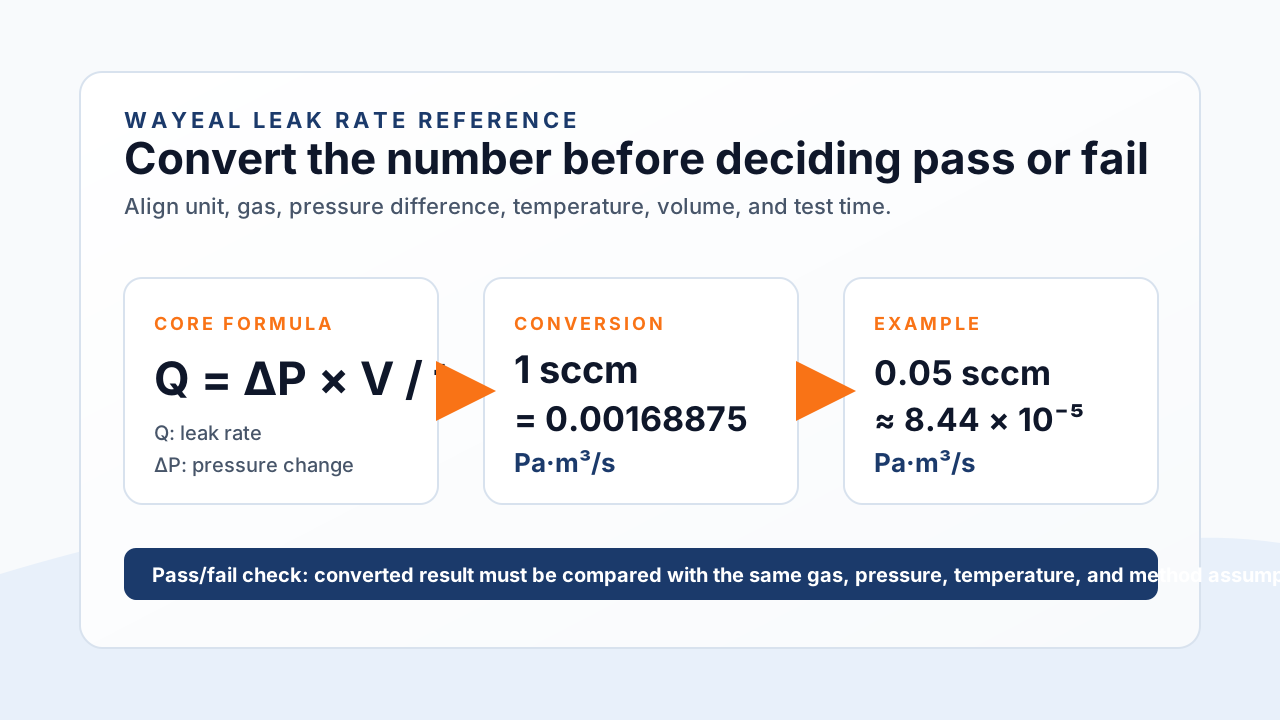
- Typical question
- Display: 0.05 sccm; drawing: 1 x 10^-4 Pa·m³/s
- Converter factor
- 1 sccm = 0.00168875 Pa·m³/s
- Worked result
- 0.05 sccm = about 8.44 x 10^-5 Pa·m³/s
- Decision rule
- Compare only under the same gas, pressure, and standard conditions
A leak tester may show 0.05 sccm while the customer drawing allows 1 x 10^-4 Pa·m³/s. Before deciding pass or fail, convert the result and confirm that the same gas, pressure difference, temperature, and test method assumptions apply.
Leak rate tells how much gas passes through a leak path per unit time. Because gas is compressible, volume alone is not enough. Practical leak-rate units combine pressure, volume, and time so engineering teams can compare specifications consistently.
Definition
What Leak Rate Means
Leak rate is gas flow through a leak under a pressure difference. For direct pressure or vacuum pressure-rise calculations, the simple relationship is Q = ΔP x V / t.
If a sealed 1 m³ evacuated vessel rises by 1 Pa in 1 second, the leak rate is 1 Pa·m³/s. The same idea in mbar·L/s: if a 1 L vessel changes by 1 mbar in 1 second, the leak rate is 1 mbar·L/s.
Unit names
Common Leak Rate Units
Pa·m³/s
SI-style leak-rate unit used in high-precision engineering and many vacuum helium leak testing specifications.
mbar·L/s
Very common in helium leak detection and vacuum work, especially in European-style instrument and process specifications.
atm·cc/s
Atmosphere cubic centimeters per second. It is common in U.S. and Japanese leak-test specifications.
sccm
Standard cubic centimeters per minute. It is common on air leak testers and flow-style production specifications.
ccm and accm
ccm is a volume-per-minute expression. accm is actual cubic centimeters per minute and depends on actual pressure and temperature.
ppm
ppm is concentration, not leak rate. It can support sniffer or accumulation tests only with sampling flow, volume, and time context.
Quick reference
Useful Unit Conversions
Wayeal uses the same conversion constants on this page as the leak rate unit converter. For sccm, the practical relationship is 1 sccm = 0.00168875 Pa·m³/s.
| Starting unit | Pa·m³/s | mbar·L/s | sccm |
|---|---|---|---|
| 1 Pa·m³/s | 1 | 10 | 592.154 |
| 1 mbar·L/s | 0.1 | 1 | 59.2154 |
| 1 atm·cc/s | 0.101325 | 1.01325 | 60 |
| 1 sccm | 0.00168875 | 0.0168875 | 1 |
Calculation
Worked Examples for Specifications
Example 1: convert 0.05 sccm into Pa·m³/s. The calculation is 0.05 x 0.00168875 = 0.0000844375 Pa·m³/s, or about 8.44 x 10^-5 Pa·m³/s. If the acceptance limit is 1 x 10^-4 Pa·m³/s, the converted value is below the limit under the same assumptions.
Example 2: convert a pressure-decay result into leak rate. If V = 5 cm³ = 5 x 10^-6 m³, ΔP = 20 Pa, and t = 10 s, then Q = 20 x 5 x 10^-6 / 10 = 1 x 10^-5 Pa·m³/s.
Converted back to sccm, 1 x 10^-5 Pa·m³/s divided by 0.00168875 is about 0.0059 sccm.
Method selection
Which Unit Should I Use?
Vacuum helium testing
Use mbar·L/s or Pa·m³/s when discussing vacuum chambers, helium spray testing, and high-sensitivity mass spectrometer leak detection.
Flow-style production limits
Use sccm or atm·cc/s when a customer specification or air leak tester reports standardized flow through the leak path.
Pressure decay
Record the pressure drop, internal volume, and test time, then calculate Q = ΔP x V / t before comparing with other leak-rate units.
Refrigerant or product-loss limits
Use g/year or %/year only when the product gas, internal volume, pressure, temperature, and acceptance rule are defined.
Sniffer and accumulation tests
ppm can describe concentration, but it cannot be converted directly to leak rate without the sampling setup.
Calibration and traceability
Use calibrated leak standards and documented units when the acceptance limit must be repeatable across instruments, fixtures, and shifts.
Applications
Typical Leak Rate Range Framing
The bands below are orientation ranges, not universal acceptance limits. Real limits depend on product geometry, safety risk, pressure, gas, temperature, test method, and customer specification.
| Application type | Illustrative leak-rate band | Notes |
|---|---|---|
| Consumer waterproof electronics | 0.01-0.1 sccm | IP ratings cannot be reused without volume, pressure, and test-time assumptions. |
| Automotive connectors, lamps, and housings | 1-10 sccm | Often pressure-decay or air-leak oriented. |
| HVAC and refrigeration components | g/year, mbar·L/s, or Pa·m³/s | Use the refrigerant, internal volume, and pressure condition from the specification. |
| EV battery and liquid-cooling parts | Specification-dependent | Limits are tied to cooling medium, pressure, pack safety, and production takt time. |
| Medical, aerospace, and hermetic parts | <0.001 sccm or helium units | Usually requires validated tracer-gas or helium mass spectrometer testing. |
| Vacuum helium leak detection | 10^-5 to 10^-11 mbar·L/s | The useful range depends on mode, fixture, detector, and background helium. |
Specification traps
Common Mistakes to Avoid
- Do not compare sccm and Pa·m³/s without unit conversion.
- Do not treat sccm, ccm, and accm as identical unless the pressure and temperature assumptions are stated.
- Do not convert ppm directly to leak rate without sampling flow, accumulation volume, and measurement time.
- Do not reuse an IP67 or IP68 number without the product volume, pressure, and test-time assumptions.
- Do not infer hole size directly from leak rate. Gas type, pressure, path geometry, and flow regime matter.
- Do not ignore calibration. A pass/fail leak limit should be tied to a traceable reference leak or validated process.
FAQ
Leak Rate Units FAQ
Is sccm the same as cc/min?
Not always. sccm means standard cubic centimeters per minute, while cc/min can be a simple volume-per-minute expression. Confirm whether the specification means standard flow or actual flow before comparing results.
Why do helium leak detectors often use mbar·L/s?
mbar·L/s is widely used in vacuum and helium leak testing because it directly combines pressure change, volume, and time in units familiar to vacuum equipment and leak detector specifications.
Can ppm be converted directly to leak rate?
No. ppm is concentration. To estimate leak rate from ppm, the sampling flow, accumulation volume, background level, test time, and gas conditions must be known.
How do I convert pressure drop into leak rate?
Use Q = ΔP x V / t after aligning units. ΔP is pressure change, V is internal volume, and t is test time. The result can then be converted to Pa·m³/s, mbar·L/s, or sccm.
What leak-rate unit should be written on a purchase specification?
Use the unit that matches the test method and acceptance rule. Vacuum helium tests commonly use mbar·L/s or Pa·m³/s, while flow-style air leak tests often use sccm or atm·cc/s. Always state gas, pressure, temperature, volume, and test time assumptions.
Need to convert a leak rate?
Use the Wayeal converter for quick comparisons between Pa·m³/s, mbar·L/s, atm·cc/s, Torr·L/s, and sccm before writing or accepting a leak-rate specification.
Open Unit Converter